During his Oxford days, Pinter was reckoned an ace oarsman and was a favourite of the boat-race team. One day he met up with his pal Orwell for a drink. As he rose to go to the bar, Orwell couldn’t help noticing that the seat of his trousers was sodden wet. Exercising the greatest possible tact, he pointed this out.
Pinter grimaced. “Ah, yes. We were out practicing, you see, and sprung a leak. A very small one, and so we kept on blithely rowing without noticing the water until it was almost at our ankles. Our fault, really, we’ve been putting the craft under too much strain lately.”
Orwell nodded agreement. “Actions have consequences, old boy. You seep as you row.”
Showing posts with label short fiction. Show all posts
Showing posts with label short fiction. Show all posts
Friday, 23 March 2012

Saturday, 10 March 2012
Meanwhile, in the 1930s...
I have had great fun reading Orlando and have felt for some time an urge to give it the sort of affectionate parody that I gave Jane Eyre. The problem is, a parody of Orlando would be Orlando only not as good.
Here's something, however. One of my favourite bits of the novel is the stuff about The Spirit of the Age, so I decided to create a scene in which the Age it helped to define gives way to a new one.
The scene was a moderately-sized country residence amidst its grounds. Autumn was coming: the landscape of that well-known but elusive place, which has had libraries written about it but cannot be found on an OS map, Rural England, looked dignified but weary. Everything was at its most achingly beautiful and also its most painfully transitory. Birds sang about mortality. Petals fell from roses with exaggerated slowness.
Inside the house, some of the rising and established stars of English literature had gathered for tea and debate. It was impressive to hear: with only their words, they dismantled centuries of literary heritage and re-assembled it in new and exciting shapes. They were very keen, indeed, on the new and exciting. There was little of it to be found occurring naturally on their snoozing amber island, forcing them into more and more extreme experimentation: they ripped up the boundaries of class, race, gender, time, and space.
Were one in a position to listen quietly in at the breakfast table on a particular September morning, one could here all of the following: the renowned critic Scratching demonstrating that Donne had been the first modernist; Euphrosinia Plum-Duff proving that being a man and being a woman were both equally impossible; a recitation by the avant-garde poet Smealley in which the motor-car was hymned as the lily of the 20th century; a discussion of the latest piece by Schotterboldt, ‘Man in blackface coughing repeatedly on the piano keys’; and a lot of really quite good homoerotic stuff.
Young David Oats, who had been proclaimed the proletarian Blake of the 20th century by Scratching, speared himself a fried egg with a sense of vague unease. It is true that any proper socialist feels uneasy after his fourth fried egg, but he had long since convinced himself that socialism did not mean that nobody would have four fried eggs for breakfast: it meant that everybody would, and so for a son of the mines to enjoy them in a country house amongst the finest intellectuals of the age was no doubt a step in the right direction. The left direction, that is.
But still, he felt troubled. He took advantage of a lull in the conversation to get up and go over to the French window. From this admirable vantage point, he witnessed one of the decisive moments in history. (It is true that nothing really decisive had ever happened at Tanglethorn Hall per se. But a look out of the French windows revealed a general world phenomenon.)
Storm clouds gathered, fat, black, and bombastic. Then they broke. Then they gathered again. Then they broke again. Then they gathered again. Then they broke again. It was clear that this process would continue for some time.
The rains they poured down instantly sent the entire world into a grim, soggy, demoralizing winter. All sorts of extra-ordinary things took place. In China, the piercing claws of a small, agile dragon in an awful pince-nez stirred a far larger, older, craggier dragon from its ancient slumber (although this all took place in conditions of immense inscrutability). In America, the party was declared over and the drunken guests were fished out of the swimming-pool and driven home, where to their horror they discovered that most people in America weren’t obscenely rich. In Russia, muscular heroes of labour were sent to sink a mine-shaft into the unexplored and surpassingly deep depths of the Slavic Soul. In Germany, a magnificent cabaret about the end of civilization had to be suspended in the middle of the second act when the theatre ran out of money and the producer was sent to a concentration camp. India, which up to then had been all adventurous Afghan frontier until you got to the temples of lost civilizations, turned out to be miles and miles of bloody India, full of coolies joining trade-unions and political parties. Africa was shown to exist for the first time.
Weighed down by heavy thoughts (and possibly also fried egg, we must confess) Oats returned to the breakfast table, listening to the rain patter on the roof like the machine-guns of aircraft in the coming war, which everybody had just realized was inevitable.
The atmosphere had changed in his absence. Scratching had joined the Communist Party and was now showing that Donne had been a pioneering Marxist. Euphrosynia Plum-Duff was trying to prevent the war by sponsoring seminars; everybody of course knew that the war was inevitable, but this only made them feel even more urgently the need for seminars. Smealey had gone off to Tuscany on invitation from Mussolini, but the company had been made up again by Schotterboldt, who had had to flee into exile.
Breakfast was allowed to go stale as everybody chewed on the world crisis. The servants came in to clear it away, and several people felt intense existential guilt about their existence.
Oats, who was particularly so affected, went outside to watch the drizzle on the hillsides. He lit a soggy fag and puffed at it, discontentedly. Standing in the doorway, we has suddenly jostled aside by the Scotsman Robert Wilson, who was on his way to catch a train.
Not much has been seen of Wilson at Tanglethorn that Summer except at dinner-time: he had been invited to replace a whole succession of Irishmen, all of whom had succumbed to the urge to travel to Paris which affects the men of Eirinn so strongly for some reason, as a provider of Celticism; but when it turned out that his brand involved no Lillies of the 20th century but only the potatoes, rain, poverty, and Calvinism of the 20th century he had fallen out of favour. These were the things literature was supposed to help abolish, people felt, or at any rate successfully ignore.
Oats had thought he might have stayed around to gloat now that the march of history had so eloquently proved him right, but as he explained, he suddenly felt an irresistible calling to alight on his native moors, there to brood more satisfactorily. Unfortunately Oats didn’t understand much of this, as Wilson said it in a new form of broad Scots which he had just invented.
Oats wished he had a native moor: he could do with a bit of brooding-room. He scanned the rainy grey horizon of Rural England. In a rush its oldness, its grayness, the endearing mediocrity of its landscape suddenly overcame him in a way that would have been quite impossible when it was the centre of the world, the sun never set on it, and its roses never wilted. Wilted roses, dead trees, and slag-heaps seemed suddenly to find their voices and join in a chorus of forgotten hymns.
Thunder rumbled in the distance, and the rain intensified. Oats sighed significantly.
Well, he said in the privacy of his mind, there’s nothing else for it. I shall have to fight fascism.
Here's something, however. One of my favourite bits of the novel is the stuff about The Spirit of the Age, so I decided to create a scene in which the Age it helped to define gives way to a new one.
The scene was a moderately-sized country residence amidst its grounds. Autumn was coming: the landscape of that well-known but elusive place, which has had libraries written about it but cannot be found on an OS map, Rural England, looked dignified but weary. Everything was at its most achingly beautiful and also its most painfully transitory. Birds sang about mortality. Petals fell from roses with exaggerated slowness.
Inside the house, some of the rising and established stars of English literature had gathered for tea and debate. It was impressive to hear: with only their words, they dismantled centuries of literary heritage and re-assembled it in new and exciting shapes. They were very keen, indeed, on the new and exciting. There was little of it to be found occurring naturally on their snoozing amber island, forcing them into more and more extreme experimentation: they ripped up the boundaries of class, race, gender, time, and space.
Were one in a position to listen quietly in at the breakfast table on a particular September morning, one could here all of the following: the renowned critic Scratching demonstrating that Donne had been the first modernist; Euphrosinia Plum-Duff proving that being a man and being a woman were both equally impossible; a recitation by the avant-garde poet Smealley in which the motor-car was hymned as the lily of the 20th century; a discussion of the latest piece by Schotterboldt, ‘Man in blackface coughing repeatedly on the piano keys’; and a lot of really quite good homoerotic stuff.
Young David Oats, who had been proclaimed the proletarian Blake of the 20th century by Scratching, speared himself a fried egg with a sense of vague unease. It is true that any proper socialist feels uneasy after his fourth fried egg, but he had long since convinced himself that socialism did not mean that nobody would have four fried eggs for breakfast: it meant that everybody would, and so for a son of the mines to enjoy them in a country house amongst the finest intellectuals of the age was no doubt a step in the right direction. The left direction, that is.
But still, he felt troubled. He took advantage of a lull in the conversation to get up and go over to the French window. From this admirable vantage point, he witnessed one of the decisive moments in history. (It is true that nothing really decisive had ever happened at Tanglethorn Hall per se. But a look out of the French windows revealed a general world phenomenon.)
Storm clouds gathered, fat, black, and bombastic. Then they broke. Then they gathered again. Then they broke again. Then they gathered again. Then they broke again. It was clear that this process would continue for some time.
The rains they poured down instantly sent the entire world into a grim, soggy, demoralizing winter. All sorts of extra-ordinary things took place. In China, the piercing claws of a small, agile dragon in an awful pince-nez stirred a far larger, older, craggier dragon from its ancient slumber (although this all took place in conditions of immense inscrutability). In America, the party was declared over and the drunken guests were fished out of the swimming-pool and driven home, where to their horror they discovered that most people in America weren’t obscenely rich. In Russia, muscular heroes of labour were sent to sink a mine-shaft into the unexplored and surpassingly deep depths of the Slavic Soul. In Germany, a magnificent cabaret about the end of civilization had to be suspended in the middle of the second act when the theatre ran out of money and the producer was sent to a concentration camp. India, which up to then had been all adventurous Afghan frontier until you got to the temples of lost civilizations, turned out to be miles and miles of bloody India, full of coolies joining trade-unions and political parties. Africa was shown to exist for the first time.
Weighed down by heavy thoughts (and possibly also fried egg, we must confess) Oats returned to the breakfast table, listening to the rain patter on the roof like the machine-guns of aircraft in the coming war, which everybody had just realized was inevitable.
The atmosphere had changed in his absence. Scratching had joined the Communist Party and was now showing that Donne had been a pioneering Marxist. Euphrosynia Plum-Duff was trying to prevent the war by sponsoring seminars; everybody of course knew that the war was inevitable, but this only made them feel even more urgently the need for seminars. Smealey had gone off to Tuscany on invitation from Mussolini, but the company had been made up again by Schotterboldt, who had had to flee into exile.
Breakfast was allowed to go stale as everybody chewed on the world crisis. The servants came in to clear it away, and several people felt intense existential guilt about their existence.
Oats, who was particularly so affected, went outside to watch the drizzle on the hillsides. He lit a soggy fag and puffed at it, discontentedly. Standing in the doorway, we has suddenly jostled aside by the Scotsman Robert Wilson, who was on his way to catch a train.
Not much has been seen of Wilson at Tanglethorn that Summer except at dinner-time: he had been invited to replace a whole succession of Irishmen, all of whom had succumbed to the urge to travel to Paris which affects the men of Eirinn so strongly for some reason, as a provider of Celticism; but when it turned out that his brand involved no Lillies of the 20th century but only the potatoes, rain, poverty, and Calvinism of the 20th century he had fallen out of favour. These were the things literature was supposed to help abolish, people felt, or at any rate successfully ignore.
Oats had thought he might have stayed around to gloat now that the march of history had so eloquently proved him right, but as he explained, he suddenly felt an irresistible calling to alight on his native moors, there to brood more satisfactorily. Unfortunately Oats didn’t understand much of this, as Wilson said it in a new form of broad Scots which he had just invented.
Oats wished he had a native moor: he could do with a bit of brooding-room. He scanned the rainy grey horizon of Rural England. In a rush its oldness, its grayness, the endearing mediocrity of its landscape suddenly overcame him in a way that would have been quite impossible when it was the centre of the world, the sun never set on it, and its roses never wilted. Wilted roses, dead trees, and slag-heaps seemed suddenly to find their voices and join in a chorus of forgotten hymns.
Thunder rumbled in the distance, and the rain intensified. Oats sighed significantly.
Well, he said in the privacy of his mind, there’s nothing else for it. I shall have to fight fascism.
Monday, 5 March 2012
Down with non-partisan bloggers!
We're back! That is to say myself, my camera, my dinner, and my muse (the latter two are possibly one and the same). And here is the proof:
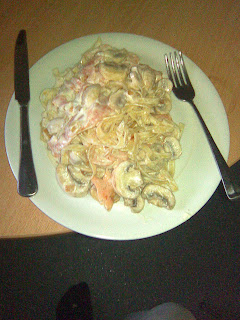
My budget was in a small surplus the other day: I could have gotten myself a new shirt, or an album on iTunes. I could have saved up to repair my bicycle, or helped end world hunger. I could have blown it all on sin and vice. But why would I do any of those things when I could have smoked salmon for tea?
Well, anyway, there are no more excuses to not be writing. Essays are done, and what is more, after much lingering awkwardly at the door, twiddling on the balls of her feet, Spring has come to Scotland! The sun spills light on sandstone and slate; buds blossom brightly in the Botanics; alliteration adds appeal. The lines of hills beyond Glasgow have gone from iron-grey to cautiously green; even the moss and creepers on the bare trees seem to have a richer colour.
It is just as well that my essays are indeed done: so that I can take time to go outside and write things using a pen and paper as my ancestors did in ancient days, yes; but also because Winter is a much more suitable season for the stern Marxist finger-wagging of which my essays invariably consist. Some residue of revolutionary fervour is left, however, and under the touch of the sun it has taken on a rather whimsical character.
During the long lead-up to the opening of the preliminaries of the preparation for the first round of the contest that precedes the American presidential election, we heard from various mouths that Corporations are People and they (as distinct from the people who own them and whom they employ) have all the rights of Americans. I wait keenly for the state of Texas to execute one. The whole idea seems to me an eloquently stupid example of how we have been accustomed to viewing society in late decades: as a mechanism for defending us, by tributes of treasure and the periodic sacrifice of a virgin welfare-state, against the dragon Economy. Nobody can predict the continent-shaking stirrings of this beast - who is certainly not just people making things and doing things whose relations might be re-organised to the general good. No, it is something beyond mere mortal kenning, with breath like the desert wind and a mouth like the pit of damnation.
But rather than just get pissed off, I decided to follow on with the idea of 'corporate personhood'. There follows part 1 of, hopefully, a recurring series.
Jonathan Bracejaw turned. He tossed. He turned again. He tossed again. All to no avail: sleep eluded him. He was tired, more tired than he had felt in a long time; but tonight... it was almost as if some alien presence were lying there in the darkness, forbidding sleep, watching him.
In point of fact of course there was a presence in the bed beside him, that of Marmalade. Marmalade, I should clarify, was a young woman (the bed had been stained with a great many things literal and metaphorical but never orange-flavoured jam) whose real name was Marya Sergeevna Bondaruka, or had been, long ago and far away; her pseudonym arose from a misunderstanding. But she was not really alien: she, or somebody physically very much like her (by surgical means, if necessary) had become something of a fixture.
Still, Jonathan could have done without her. She snored like a soprano sawmill, which cut across his ideas of how blonde amply-breasted young women to whom the adjective 'lithe' might be applied if anybody could tell me what it meant were supposed to behave, at any rate on the job. And he found it particularly distressing now: he felt, as he so seldom did, a need to think in the quiet and the dark.
After several attempts - the covers were all over the place - he kicked her.
"How much do I owe you?"
"Yeet's thriy o'clawk yeen the mauwrneeng," she said indistinctly. She could actually speak English with a cut-glass Home Counties accent, but she had learned not to: like the snoring, about which nothing could be done, it for some reason upset people.
"What, 'nothing', did you say?"
"Oh, peeez awf. Fawr-hahndred."
Jonathan clambered out of the bed and shivered. He disliked being naked as a rule (why he was willing to pay four-hundred dollars for a procedure to which nakedness was more-or-less essential is a question for the sociologists): it turned his imposing height into gangliness. "It wasn't worth it," he said as he fumbled for the money kept on his desk for this purpose.
"I know the feeling," said Marmalade irritably, neglecting her accent.
"Clear out." He tossed a wad at her with vehemence.
"I have to get dressed!"
"Do it in the toilet."
She sighed, got out of the bed, and switched on the lights. For all that her naked body, besides being the sort to which the poets and rock-and-roll stars of the human race have devoted too many fine words to justify me any adding some more, was entirely natural and just went to show what comes of a healthy diet and frequent exercise, the sight of it did not arose Jonathan so much as a fully-clothed and icy secretary of even moderate beauty would have: some mixture of gnawing guilt, distractedness, and excessive familiarity was the reason. He occupied himself in gathering up his own clothes from the floor.
"This is disgusting!," said a voice from the bathroom as he wrestled with his underwear.
"Fuck off back to Russia!"
"Ukraine!"
"Fuck off!"
He slumped on the bed, stared at the ceiling of his office, and listened to the receding sound of some exceedingly high heels. He was alone, for a little while at least. When he was alone, he felt less profoundly lonely.
But now it was no good. The ceiling was too large and bright, so he turned over, and found the pillow too dark and mysterious. A nagging voice - like his own, but not quite his own, belonging to his younger, better self, or to his conscience, or possibly to his mother - kept asking him how long it had been since he'd talked to someone he didn't, in one way or another, employ. He urged silence on the voice, but it took no heed: it wondered aloud where Marmalade had gone, and whether she was sparing him a thought; it speculated about these distant countries which he had never visited even though their citizens had almost certainly contributed to his fortune, Russia and Ukraine and - where had that other girl come from? Morocco! He hadn't been able to remember until now, and now he was assailed with memories. He remembered New England: the green fields, and stone walls, and the thundering green field of the Atlantic walled in by the little towns where he had spent his childhood. He had visions - wildly inaccurate, the dutiful narrator must record - of Russian, Ukrainian, Moroccan childhoods, and the hopes they nurtured, and the memories they left to torment their exiled children years later, in other countries, their hopes betrayed. And had he, who had ended up on top of them in the same soiled bed, done any better?
This was not the first such episode, though it was the most intense to date, and it would have ended as they all did - drowned in an artisan vodka that was, with an irony Jonathan might have appreciated had he ever noticed, Ukrainian - had it not been for one of those inexplicable farts of the vast digestive system of the universe.
It is necessary here to draw back the all-seeing narrative eye from Jonathan's office on the 567th floor of the LifeSunTechGrowLife Industries Building and cast it a short distance into the past. There we can view a sum of money orders of magnitude than that paid to the long-suffering Marmalade as it is transferred from the accounts of LifeSunTechGrowLife Industries to a gentleman with the rather absurd name of Athanasius McGill, an utterly trustworthy person, who pools it with even more money and distributes the whole to representatives and senators of the great United States.
As a result of all this, reality was altered in a small but important respect. After all, the United States government is certainly the most powerful institution ever constructed by humans, and if they can't alter the universe, who the hell can, I ask you? They have the power to legislate that green is blue and so it shall be. This explains a great deal. And if, a mere author of frivolous fiction, can cause such a person as Jonathan Bracejaw to exist, then the United States government can by the same means as me create whole categories of person.
The United States government declared that LifeSunTechGrowth Industries was as much a person as Athanasius McGill and Jonathan Bracejaw and Marmalade - possibly moreso than her, in fact. And so it was.
Now, we skip ahead again, to where we left Jonathan deep in introspection, guilt, and self-confrontation. By an astonishing coincidence, it was just as he made a heartfelt appeal to whatever higher power his battered soul believed in for company that the bill which he had a part in creating was passed into law, and caused his cry to be heeded in a highly - even an excessively - literal fashion.
There was a brisk knock at the door.
'Mr. Bracejaw, sir?'

My budget was in a small surplus the other day: I could have gotten myself a new shirt, or an album on iTunes. I could have saved up to repair my bicycle, or helped end world hunger. I could have blown it all on sin and vice. But why would I do any of those things when I could have smoked salmon for tea?
Well, anyway, there are no more excuses to not be writing. Essays are done, and what is more, after much lingering awkwardly at the door, twiddling on the balls of her feet, Spring has come to Scotland! The sun spills light on sandstone and slate; buds blossom brightly in the Botanics; alliteration adds appeal. The lines of hills beyond Glasgow have gone from iron-grey to cautiously green; even the moss and creepers on the bare trees seem to have a richer colour.
It is just as well that my essays are indeed done: so that I can take time to go outside and write things using a pen and paper as my ancestors did in ancient days, yes; but also because Winter is a much more suitable season for the stern Marxist finger-wagging of which my essays invariably consist. Some residue of revolutionary fervour is left, however, and under the touch of the sun it has taken on a rather whimsical character.
During the long lead-up to the opening of the preliminaries of the preparation for the first round of the contest that precedes the American presidential election, we heard from various mouths that Corporations are People and they (as distinct from the people who own them and whom they employ) have all the rights of Americans. I wait keenly for the state of Texas to execute one. The whole idea seems to me an eloquently stupid example of how we have been accustomed to viewing society in late decades: as a mechanism for defending us, by tributes of treasure and the periodic sacrifice of a virgin welfare-state, against the dragon Economy. Nobody can predict the continent-shaking stirrings of this beast - who is certainly not just people making things and doing things whose relations might be re-organised to the general good. No, it is something beyond mere mortal kenning, with breath like the desert wind and a mouth like the pit of damnation.
But rather than just get pissed off, I decided to follow on with the idea of 'corporate personhood'. There follows part 1 of, hopefully, a recurring series.
Jonathan Bracejaw turned. He tossed. He turned again. He tossed again. All to no avail: sleep eluded him. He was tired, more tired than he had felt in a long time; but tonight... it was almost as if some alien presence were lying there in the darkness, forbidding sleep, watching him.
In point of fact of course there was a presence in the bed beside him, that of Marmalade. Marmalade, I should clarify, was a young woman (the bed had been stained with a great many things literal and metaphorical but never orange-flavoured jam) whose real name was Marya Sergeevna Bondaruka, or had been, long ago and far away; her pseudonym arose from a misunderstanding. But she was not really alien: she, or somebody physically very much like her (by surgical means, if necessary) had become something of a fixture.
Still, Jonathan could have done without her. She snored like a soprano sawmill, which cut across his ideas of how blonde amply-breasted young women to whom the adjective 'lithe' might be applied if anybody could tell me what it meant were supposed to behave, at any rate on the job. And he found it particularly distressing now: he felt, as he so seldom did, a need to think in the quiet and the dark.
After several attempts - the covers were all over the place - he kicked her.
"How much do I owe you?"
"Yeet's thriy o'clawk yeen the mauwrneeng," she said indistinctly. She could actually speak English with a cut-glass Home Counties accent, but she had learned not to: like the snoring, about which nothing could be done, it for some reason upset people.
"What, 'nothing', did you say?"
"Oh, peeez awf. Fawr-hahndred."
Jonathan clambered out of the bed and shivered. He disliked being naked as a rule (why he was willing to pay four-hundred dollars for a procedure to which nakedness was more-or-less essential is a question for the sociologists): it turned his imposing height into gangliness. "It wasn't worth it," he said as he fumbled for the money kept on his desk for this purpose.
"I know the feeling," said Marmalade irritably, neglecting her accent.
"Clear out." He tossed a wad at her with vehemence.
"I have to get dressed!"
"Do it in the toilet."
She sighed, got out of the bed, and switched on the lights. For all that her naked body, besides being the sort to which the poets and rock-and-roll stars of the human race have devoted too many fine words to justify me any adding some more, was entirely natural and just went to show what comes of a healthy diet and frequent exercise, the sight of it did not arose Jonathan so much as a fully-clothed and icy secretary of even moderate beauty would have: some mixture of gnawing guilt, distractedness, and excessive familiarity was the reason. He occupied himself in gathering up his own clothes from the floor.
"This is disgusting!," said a voice from the bathroom as he wrestled with his underwear.
"Fuck off back to Russia!"
"Ukraine!"
"Fuck off!"
He slumped on the bed, stared at the ceiling of his office, and listened to the receding sound of some exceedingly high heels. He was alone, for a little while at least. When he was alone, he felt less profoundly lonely.
But now it was no good. The ceiling was too large and bright, so he turned over, and found the pillow too dark and mysterious. A nagging voice - like his own, but not quite his own, belonging to his younger, better self, or to his conscience, or possibly to his mother - kept asking him how long it had been since he'd talked to someone he didn't, in one way or another, employ. He urged silence on the voice, but it took no heed: it wondered aloud where Marmalade had gone, and whether she was sparing him a thought; it speculated about these distant countries which he had never visited even though their citizens had almost certainly contributed to his fortune, Russia and Ukraine and - where had that other girl come from? Morocco! He hadn't been able to remember until now, and now he was assailed with memories. He remembered New England: the green fields, and stone walls, and the thundering green field of the Atlantic walled in by the little towns where he had spent his childhood. He had visions - wildly inaccurate, the dutiful narrator must record - of Russian, Ukrainian, Moroccan childhoods, and the hopes they nurtured, and the memories they left to torment their exiled children years later, in other countries, their hopes betrayed. And had he, who had ended up on top of them in the same soiled bed, done any better?
This was not the first such episode, though it was the most intense to date, and it would have ended as they all did - drowned in an artisan vodka that was, with an irony Jonathan might have appreciated had he ever noticed, Ukrainian - had it not been for one of those inexplicable farts of the vast digestive system of the universe.
It is necessary here to draw back the all-seeing narrative eye from Jonathan's office on the 567th floor of the LifeSunTechGrowLife Industries Building and cast it a short distance into the past. There we can view a sum of money orders of magnitude than that paid to the long-suffering Marmalade as it is transferred from the accounts of LifeSunTechGrowLife Industries to a gentleman with the rather absurd name of Athanasius McGill, an utterly trustworthy person, who pools it with even more money and distributes the whole to representatives and senators of the great United States.
As a result of all this, reality was altered in a small but important respect. After all, the United States government is certainly the most powerful institution ever constructed by humans, and if they can't alter the universe, who the hell can, I ask you? They have the power to legislate that green is blue and so it shall be. This explains a great deal. And if, a mere author of frivolous fiction, can cause such a person as Jonathan Bracejaw to exist, then the United States government can by the same means as me create whole categories of person.
The United States government declared that LifeSunTechGrowth Industries was as much a person as Athanasius McGill and Jonathan Bracejaw and Marmalade - possibly moreso than her, in fact. And so it was.
Now, we skip ahead again, to where we left Jonathan deep in introspection, guilt, and self-confrontation. By an astonishing coincidence, it was just as he made a heartfelt appeal to whatever higher power his battered soul believed in for company that the bill which he had a part in creating was passed into law, and caused his cry to be heeded in a highly - even an excessively - literal fashion.
There was a brisk knock at the door.
'Mr. Bracejaw, sir?'
Tuesday, 14 February 2012
I said I wouldn't...
...But I did! There follows another incident from the increasingly improbable adventures of Orwell and Pinter.
Orwell and Pinter were both very fond of flowers and cultivated them in boxes on the windowsills of their London flat. They took to keeping bags of seeds about their persons and planting these in forgotten corners of soil - at road junctions, for instance. Many died, but occasionally they bloomed, and added a splash of joyous colour to the bleak prospects of the city.
They bought their seeds from the establishment of one Donald Armstrong. He was a Scotsman by birth: his family had been a great name among the Border-reivers, those dauntless cossacks of Great Britain. Once, they had terrorised the Marches and dined at the table of the kings of Scotland; but the wild days ended, and the family settled down and became respectable landowners and keen gardeners. So keen, in fact, that each succeeding Armstrong's landscaping of the family seat began to use up the money. Donald's grandfather Pertinax had in the end sold the estate to a wealthy American and set up a rightly-praised florist's shop in Galashiels, which was flourishing when Donald came into the ownership. With a riever-like disregard for frontiers where there was loot to be made, he decided to move operations to London, and there gained a great and similarly riever-like reputation for throwing feasts on behalf of various London Scots fraternities.
But though he now ranked as a prosperous businessman, he maintained a close personal interest in his produce and was famed in particular as a breeder of tulips. One experiment of his - prosaically called the Number 4 - was thought to be quite exquisite by all, and certainly by Orwell and Pinter. Though they would chat amiably on gardening matters, Armstrong would not reveal even to his favoured customers the jealously-guarded secret of the Number 4. But he always kept a few packets of seeds behind his desk just in case his friends should call.
One day, however, their call found him absent. A flustered sales assistant explained that he had gone to attend a binge commemorating the Battle of Flodden, where his ancestors had fought. Unfortunately, this same assistant, ignorant of his employer's customs, had sold off all the present batch of Number 4s.
"Ah, well," said Pinter stoically. But Orwell's response was theatrical in the extreme.
"Och, A'm wae!," he said, affecting Armstrong's broad Scots dialect. Pinter gave him a funny look. "The fowers of the florist are aw wede awa!"
Orwell and Pinter were both very fond of flowers and cultivated them in boxes on the windowsills of their London flat. They took to keeping bags of seeds about their persons and planting these in forgotten corners of soil - at road junctions, for instance. Many died, but occasionally they bloomed, and added a splash of joyous colour to the bleak prospects of the city.
They bought their seeds from the establishment of one Donald Armstrong. He was a Scotsman by birth: his family had been a great name among the Border-reivers, those dauntless cossacks of Great Britain. Once, they had terrorised the Marches and dined at the table of the kings of Scotland; but the wild days ended, and the family settled down and became respectable landowners and keen gardeners. So keen, in fact, that each succeeding Armstrong's landscaping of the family seat began to use up the money. Donald's grandfather Pertinax had in the end sold the estate to a wealthy American and set up a rightly-praised florist's shop in Galashiels, which was flourishing when Donald came into the ownership. With a riever-like disregard for frontiers where there was loot to be made, he decided to move operations to London, and there gained a great and similarly riever-like reputation for throwing feasts on behalf of various London Scots fraternities.
But though he now ranked as a prosperous businessman, he maintained a close personal interest in his produce and was famed in particular as a breeder of tulips. One experiment of his - prosaically called the Number 4 - was thought to be quite exquisite by all, and certainly by Orwell and Pinter. Though they would chat amiably on gardening matters, Armstrong would not reveal even to his favoured customers the jealously-guarded secret of the Number 4. But he always kept a few packets of seeds behind his desk just in case his friends should call.
One day, however, their call found him absent. A flustered sales assistant explained that he had gone to attend a binge commemorating the Battle of Flodden, where his ancestors had fought. Unfortunately, this same assistant, ignorant of his employer's customs, had sold off all the present batch of Number 4s.
"Ah, well," said Pinter stoically. But Orwell's response was theatrical in the extreme.
"Och, A'm wae!," he said, affecting Armstrong's broad Scots dialect. Pinter gave him a funny look. "The fowers of the florist are aw wede awa!"
Saturday, 11 February 2012
Experiments in scheduling
New offerings from the steam-obscured depths of the word-kitchen! How often will these appear? I am currently computing by means of graphs and formulae how much work I can be arsed doing, but once or twice weekly seems plausible.
First, a whinge: people asking me if I have a lighter. Look, pal, we've all got our vices in this imperfect world, we're all killing ourselves somehow, I know that, I won't judge you. But why would us non-smoking members of the public go around with lighters in our pockets to facilitate you in your particular odious habit? Some people drink to excess, and nobody has ever come up to me on the street asking for a bottle-opener. I've got an odious habit of making overcomplicated puns, which will see me dead one of these days - and yet do you see me hanging around on the Murano bridge accosting people (with their arms full of shopping, too) saying 'Here mate got a proverb I could spoonerise?'. I mean, really.
Anyway, what about the food? This:

...is how I dispose of all those things I buy at the start of the week in the sure expectation of using but not in any particular amount. There's tatties, green beans, mushrooms, onion, and bacon in there: another week it might be ham, or broccoli. Obviously this is a recipe meant to be adapted, so adapt away. (You're supposed to treat all my other recipes as religious revelation. Obviously.)
Simple as anything: slice and boil the potatoes and beans, chop and fry the mushrooms and onion, grill the bacon in the meantime, and then drain the potatoes and chuck them in and, here is the special secret bit, simmer up to the ankles in three parts olive-oil to one part vinegar (white-wine, preferably) plus a spoonful of wholegrain mustard. Then spoon it all onto a plate. All of it! That's the beauty of leftover-meals. If some of it falls onto the floor, what do you even care? There's plenty where that came from; and it's Saturday night in student digs, things will be worse before the sun rises again. So dole it out, forget your manners, and scoff.
At a recent English seminar, we divided the story of Jane Eyre into five bits named, as is customary, after the various dreerily-named locales where she spends them, Thornfield and Gateshead an' aw. But we couldn't always remember which element matched which; and so eventually poor Jane was stuck somewhere called Thornwooddeanheadmoorhouse Hall.
Surely this place must exist, I thought. It's cosmically necessary. It is the dark side of England; the tails of the coin which has daffodils and Chipping Sodbury on its head; the north as it was, rain-swept and sinister, before anybody had invented Warbuton's; the location of the English nation's short but memorable fling with Elemental Passion. If it did not exist it would be necessary to create it. So I did.
Mr. Scoulswell, 33rd master of Thornwooddeanheadmoorhouse Hall, was all but lost from sight where he sat in the shadows of a cavernous old armchair, itself almost lost in the odd angles of the dusty library. Portraits of venerable ancestors peered down at him through the gloom, as if in silent censure. He ground his teeth, clenched and unclenched a fist. Outside, the rain pattered on the windows, weakly but ceaselessly, like a freezing traveler in need of shelter, knocking with failing strength at a dark unmoving door.
In his other hand he held a letter: the condition of the paper, obviously old yet not torn or crumpled, showed that it had been well-cared for - perhaps even worn thin by reading and re-reading. But now he held it with the words away from him, as if he could not bring himself to read them over yet again. What memories were there preserved in ink: memories of bygone years stained black themselves, not by ink, but by black deeds? Alas!: eyes not used to the incessant murkiness of Thornwooddeanheadmoorhouse Hall would find it impossible to discern anything.
...Hang on, though, tonight it seemed a little easier than it might have been. This fact did not escape the attention of Mr. Scoulswell, who suddenly sprang out of his chair and went over to the door, around which some excessively cheerful yellow light proved to be shining. Ah, as he'd suspected: it was Sally, the new maid from the city. She'd left all the candles lit again, contrary to express instructions. Ah, well, you couldn't get good help these days. Scoulswell muttered observations of this nature as he stalked along past long-sealed oaken portals and rusted relics of half-remembered wars, blowing out two candles of every three.
He had just reached the end of the landing and was looking back along, a look of satisfaction momentarily displacing his usual furrowed, brooding brow, when there came a mad shrieking cackle from the floor above.
Scoulswell, looking slightly perturbed, took his watch from his pocket - its wheezy tick a reminder of the mortality of man - and studied it.
"Too early, Sally!," he exclaimed irritably. "Much too early! Just when any guests will be drifting off to sleep, remember!"
A plump rosy-cheeked face peered over the stairs above. Scoulswell grimaced. It wasn't really the right impression, but then nobody could help their face. But really, she could make an effort, couldn't she? Did she really have to take such fastidious care of her teeth, for instance?
"Och, A'm awfie sorrae, sir!," said Sally, speaking broad Scots because the author couldn't do rural Yorkshire and hoped nobody would notice. Scoulswell again had cause to lament the general decline of standards.
"Never mind, never mind, you're getting better," said he, and decided not to bring up the candles. Did some long-buried - perhaps purposely suppressed - remnants of human compassion and tender feeling still dwell in a heart made hard by the cold wind of this, his native moor? Or perhaps he just couldn't put up with more of Sally's apologies, frantically sincere and entirely devoid of cryptic warnings and significant glances as they invariably were? Well, anyway, the girl would learn, eventually.
Scoulswell stalked off again down the stairs: he's had a fire lit earlier in the evening and by now it ought to have burned down to some sad and ruddy embers that would cast odd red and black patterns on is craggy features, making it suitable for a spot of light brooding before bedtime. "And try for a bit more vibrato!," he said over his shoulder, not unkindly.
But before he reached the fireplace, there came a knock on the door: loud, firm, and with a sense of grim Calvinistic inevitability. Scoulswell forced down a smile at this demonstration that some people at least knew how things ought to be done and assumed his best misanthropic glare as he opened it. Rain was blown into the corridor: his grandfather had had the house rebuilt to ensure that anyone cowering on the thresh-hold would be exposed to the prevailing winds, and that the cloak of anyone riding up the lane would billow satisfactorily.
"Who's there?," Scoulswell said, peering suspiciously into the gloom.
"Ah... says here there's an order outstanding from Thornwooddeanheadmoorhouse Hall?"
Scoulswell narrowed his eyes. "You're absolutely sure that's not Thornwooddeanheadmarshhouse Hall? A lot of people make that mistake."
"Ah... 'cor, sir, it wouldn't half be easier to read if we had some light."
Scoulswell grimaced again. And that knock had been so promising... he led the man into the half-light of the corridor, where he was revealed as a stout red-faced tradesmanlike person of about five-and-thirty years.
"Right, right, definitely moor. So, it'll be about the attic, then, sir?"
"Come with me." Looking like some sinister phantom as his long coat flapped behind him, Scoulswell ascended the stairs two at a time with a look of stony-cold determination on his face. Without a glance behind he stormed along the attic corridor and flung open one particularly ancient, singularly grim, and especially oaken portal.
He waited for a moment while the tradesman caught up, taking his wretched time about it.
"Blimey!," he said on entering, whistling and extracting a clip-board from somewhere. "Very well-appointed attic, if I may say, sir. Have you taken advantage of our services before, sir? There's a discount!"
Scoulswell's face was twisted as if in pain as he was reminded of memories on which he clearly did not wish to dwell.
"...She gave notice. Said she wanted to pursue a career on stage." As if being a madwoman in an attic wasn't a respectable career in this day and age! "Give me the quote, man."
The tradesman sucked his lips thoughtfully.
"Well, there's your standard or popular madwoman, well and truly insane, two menacing cackles per night and one on Sundays, several hours per day staring with an astonishing mixture of whistfulness and fury out of an upper window of your choice. Say... one and six a week. Five percent discount for professional men."
Hmph, thought Scoulswell, new money wanting to put on a show. Far too much of that sort of thing in the county these days. "What comes after?"
"Ah, well, sir, you mean the premier madwoman! Entirely and diabolically unhinged, five menacing cackles per night of which no less than one to be outside the bedroom door of any visiting guests, plus all domestic and catering needs seen too by another trained member of our staff, sir, a queer old hag who speaks in riddles in thick local dialect and shuffles about suspiciously anights, not less than 550 shuffling hours guaranteed. Discount for country squires. Bridal wear for the madwoman possible by arrangement, hang on, there's another sheet here for accessories..."
"Hmm. Is there another grade?"
"Oh my, you've got taste, sir! There is, in fact, for the very discerning customer, the Madwoman Deluxe. Shilling per cackle per night by order with possibilities for snatches of haunting old ballads. Troubling racial-colonial implications done specially to request, at no extra cost, mind, sir, no extra cost. Attempted murder of the customer to the highest standard at least once every two months plus birthdays and other special occasions, and any amount of assaults on guests and menacing property-destruction. You'll need to fill in this form for the symbolism, sir..."
"Yes, yes, I think that will do nicely," said Scoulswell. "How much?"
"With these facilities? Well... you're not a clergyman hiding a sinful past at all, sir? Only there's a discount... No, well, with these facilities, say, seven and four a week, and you'll not find better, sir."
Scoulswell sighed under his breath. It was getting so hard, these days, to keep up a respectable establishment.
First, a whinge: people asking me if I have a lighter. Look, pal, we've all got our vices in this imperfect world, we're all killing ourselves somehow, I know that, I won't judge you. But why would us non-smoking members of the public go around with lighters in our pockets to facilitate you in your particular odious habit? Some people drink to excess, and nobody has ever come up to me on the street asking for a bottle-opener. I've got an odious habit of making overcomplicated puns, which will see me dead one of these days - and yet do you see me hanging around on the Murano bridge accosting people (with their arms full of shopping, too) saying 'Here mate got a proverb I could spoonerise?'. I mean, really.
Anyway, what about the food? This:

...is how I dispose of all those things I buy at the start of the week in the sure expectation of using but not in any particular amount. There's tatties, green beans, mushrooms, onion, and bacon in there: another week it might be ham, or broccoli. Obviously this is a recipe meant to be adapted, so adapt away. (You're supposed to treat all my other recipes as religious revelation. Obviously.)
Simple as anything: slice and boil the potatoes and beans, chop and fry the mushrooms and onion, grill the bacon in the meantime, and then drain the potatoes and chuck them in and, here is the special secret bit, simmer up to the ankles in three parts olive-oil to one part vinegar (white-wine, preferably) plus a spoonful of wholegrain mustard. Then spoon it all onto a plate. All of it! That's the beauty of leftover-meals. If some of it falls onto the floor, what do you even care? There's plenty where that came from; and it's Saturday night in student digs, things will be worse before the sun rises again. So dole it out, forget your manners, and scoff.
At a recent English seminar, we divided the story of Jane Eyre into five bits named, as is customary, after the various dreerily-named locales where she spends them, Thornfield and Gateshead an' aw. But we couldn't always remember which element matched which; and so eventually poor Jane was stuck somewhere called Thornwooddeanheadmoorhouse Hall.
Surely this place must exist, I thought. It's cosmically necessary. It is the dark side of England; the tails of the coin which has daffodils and Chipping Sodbury on its head; the north as it was, rain-swept and sinister, before anybody had invented Warbuton's; the location of the English nation's short but memorable fling with Elemental Passion. If it did not exist it would be necessary to create it. So I did.
Mr. Scoulswell, 33rd master of Thornwooddeanheadmoorhouse Hall, was all but lost from sight where he sat in the shadows of a cavernous old armchair, itself almost lost in the odd angles of the dusty library. Portraits of venerable ancestors peered down at him through the gloom, as if in silent censure. He ground his teeth, clenched and unclenched a fist. Outside, the rain pattered on the windows, weakly but ceaselessly, like a freezing traveler in need of shelter, knocking with failing strength at a dark unmoving door.
In his other hand he held a letter: the condition of the paper, obviously old yet not torn or crumpled, showed that it had been well-cared for - perhaps even worn thin by reading and re-reading. But now he held it with the words away from him, as if he could not bring himself to read them over yet again. What memories were there preserved in ink: memories of bygone years stained black themselves, not by ink, but by black deeds? Alas!: eyes not used to the incessant murkiness of Thornwooddeanheadmoorhouse Hall would find it impossible to discern anything.
...Hang on, though, tonight it seemed a little easier than it might have been. This fact did not escape the attention of Mr. Scoulswell, who suddenly sprang out of his chair and went over to the door, around which some excessively cheerful yellow light proved to be shining. Ah, as he'd suspected: it was Sally, the new maid from the city. She'd left all the candles lit again, contrary to express instructions. Ah, well, you couldn't get good help these days. Scoulswell muttered observations of this nature as he stalked along past long-sealed oaken portals and rusted relics of half-remembered wars, blowing out two candles of every three.
He had just reached the end of the landing and was looking back along, a look of satisfaction momentarily displacing his usual furrowed, brooding brow, when there came a mad shrieking cackle from the floor above.
Scoulswell, looking slightly perturbed, took his watch from his pocket - its wheezy tick a reminder of the mortality of man - and studied it.
"Too early, Sally!," he exclaimed irritably. "Much too early! Just when any guests will be drifting off to sleep, remember!"
A plump rosy-cheeked face peered over the stairs above. Scoulswell grimaced. It wasn't really the right impression, but then nobody could help their face. But really, she could make an effort, couldn't she? Did she really have to take such fastidious care of her teeth, for instance?
"Och, A'm awfie sorrae, sir!," said Sally, speaking broad Scots because the author couldn't do rural Yorkshire and hoped nobody would notice. Scoulswell again had cause to lament the general decline of standards.
"Never mind, never mind, you're getting better," said he, and decided not to bring up the candles. Did some long-buried - perhaps purposely suppressed - remnants of human compassion and tender feeling still dwell in a heart made hard by the cold wind of this, his native moor? Or perhaps he just couldn't put up with more of Sally's apologies, frantically sincere and entirely devoid of cryptic warnings and significant glances as they invariably were? Well, anyway, the girl would learn, eventually.
Scoulswell stalked off again down the stairs: he's had a fire lit earlier in the evening and by now it ought to have burned down to some sad and ruddy embers that would cast odd red and black patterns on is craggy features, making it suitable for a spot of light brooding before bedtime. "And try for a bit more vibrato!," he said over his shoulder, not unkindly.
But before he reached the fireplace, there came a knock on the door: loud, firm, and with a sense of grim Calvinistic inevitability. Scoulswell forced down a smile at this demonstration that some people at least knew how things ought to be done and assumed his best misanthropic glare as he opened it. Rain was blown into the corridor: his grandfather had had the house rebuilt to ensure that anyone cowering on the thresh-hold would be exposed to the prevailing winds, and that the cloak of anyone riding up the lane would billow satisfactorily.
"Who's there?," Scoulswell said, peering suspiciously into the gloom.
"Ah... says here there's an order outstanding from Thornwooddeanheadmoorhouse Hall?"
Scoulswell narrowed his eyes. "You're absolutely sure that's not Thornwooddeanheadmarshhouse Hall? A lot of people make that mistake."
"Ah... 'cor, sir, it wouldn't half be easier to read if we had some light."
Scoulswell grimaced again. And that knock had been so promising... he led the man into the half-light of the corridor, where he was revealed as a stout red-faced tradesmanlike person of about five-and-thirty years.
"Right, right, definitely moor. So, it'll be about the attic, then, sir?"
"Come with me." Looking like some sinister phantom as his long coat flapped behind him, Scoulswell ascended the stairs two at a time with a look of stony-cold determination on his face. Without a glance behind he stormed along the attic corridor and flung open one particularly ancient, singularly grim, and especially oaken portal.
He waited for a moment while the tradesman caught up, taking his wretched time about it.
"Blimey!," he said on entering, whistling and extracting a clip-board from somewhere. "Very well-appointed attic, if I may say, sir. Have you taken advantage of our services before, sir? There's a discount!"
Scoulswell's face was twisted as if in pain as he was reminded of memories on which he clearly did not wish to dwell.
"...She gave notice. Said she wanted to pursue a career on stage." As if being a madwoman in an attic wasn't a respectable career in this day and age! "Give me the quote, man."
The tradesman sucked his lips thoughtfully.
"Well, there's your standard or popular madwoman, well and truly insane, two menacing cackles per night and one on Sundays, several hours per day staring with an astonishing mixture of whistfulness and fury out of an upper window of your choice. Say... one and six a week. Five percent discount for professional men."
Hmph, thought Scoulswell, new money wanting to put on a show. Far too much of that sort of thing in the county these days. "What comes after?"
"Ah, well, sir, you mean the premier madwoman! Entirely and diabolically unhinged, five menacing cackles per night of which no less than one to be outside the bedroom door of any visiting guests, plus all domestic and catering needs seen too by another trained member of our staff, sir, a queer old hag who speaks in riddles in thick local dialect and shuffles about suspiciously anights, not less than 550 shuffling hours guaranteed. Discount for country squires. Bridal wear for the madwoman possible by arrangement, hang on, there's another sheet here for accessories..."
"Hmm. Is there another grade?"
"Oh my, you've got taste, sir! There is, in fact, for the very discerning customer, the Madwoman Deluxe. Shilling per cackle per night by order with possibilities for snatches of haunting old ballads. Troubling racial-colonial implications done specially to request, at no extra cost, mind, sir, no extra cost. Attempted murder of the customer to the highest standard at least once every two months plus birthdays and other special occasions, and any amount of assaults on guests and menacing property-destruction. You'll need to fill in this form for the symbolism, sir..."
"Yes, yes, I think that will do nicely," said Scoulswell. "How much?"
"With these facilities? Well... you're not a clergyman hiding a sinful past at all, sir? Only there's a discount... No, well, with these facilities, say, seven and four a week, and you'll not find better, sir."
Scoulswell sighed under his breath. It was getting so hard, these days, to keep up a respectable establishment.
Tuesday, 7 February 2012
Pork and puns
Tonight's theme: things that aren't appreciated enough. The first is pork. People tend to associate it with chubby flavourlessness, but a pork chop is a canvas you can paint on. Here's a dish I have quite often:
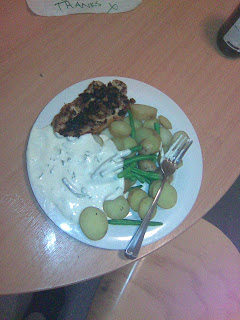
First chop up some new potatoes and trim a handful of green beans (I don't have any means of weighing my ingredients, so I'm using measures like your granny used to). Then take a couple of slices of bread - depends on the thickness; if you use too much you can always throw away the surplus - and cut off the crusts. White, even-textured bread is best. Tear up your slices and crumble them into a bowl. If you have a basically violent and destructive nature - and come on, of course you do, we deal in Scottish literature around here - this is a very socially-acceptable way to give it vent.
Now grate in most of the zest of a lemon and add about a tablespoon of oregano. Mix it all up, and squeeze half the lemon-juice into a vessel of some kind. Coat a pork-chop in the juice - a pastry-brush is good, but otherwise just dip it - and then shoogle it about in the breadcrumb-mixture until coated. Be sure and keep the juice.
Put a frying-pan on a high-heat and drop in a thin shaving of butter, then plonk the chop right down on top of it as it melts. Turn over frequently, adding new shavings as required. You may well have to make running repairs with more juice and mixture. While you're at it boil those potatoes in salted water.
Once your pork is well-coated and ready to eat, pop it onto the plate to cool. By this point you can chuck in the beans with the potatoes, since they should be nearly ready. As they finish off, squodge mayo (it's good for you!) into the lemon-juice and mix until the result has the consistency of single-cream. Then mix in a spoonful of finely-chopped parsley.
Drain the veggies, put them on the plate, and spoon the lemon-mayo over everything. Then eat, like so:

Now, a writer whose not appreciated enough: the Irish humorist Flann O'Brien, who also wrote as Myles na g'Copaleen. Very precise language, very funny, and suffused at times with sinister rainy malevolence. Definitely worth a look under both names.
One of the regular features in his column for the Irish Times were episodes concerning the poets Keats and Chapman. In these vignettes, narrated with a wonderful economy of style, the due go on anachronistic slapstick adventures, always ending in a gut-wrenching pun from Keats which the whole thing was supposed to set up.
Owing to an incurable mental condition resulting from irresponsible parenting, I think puns are really funny, so I had a shot at the form myself, taking for my characters George Orwell and Harold Pinter because whyever not? I have chronicled their adventures in many countries, but I'm going to post them all in a oner because if this blog turned into a regular pun-venue I'd have to give up the sordid remnants of my dignity.
Here, then, are the implausible adventures of Orwell and Pinter. Small doses recommended.
Orwell and Pinter in: Do svidaniya, Rodina!
The time was the late 40s, and Orwell and Pinter were for some reason or other residing in a steel-making town in the northern part of Lanarkshire, an orbital of the Greater Glasgow conurbation and home to a famous football club who play in claret and amber strips. But their quiet existence among the steel-men was cut short when a telegram arrived from the government. It was urgently necessary that the men should travel to the USSR and perform, under the guise of a literary tour, a mission of such absolute secrecy and importance that I won't be able to include it in this story until the secrecy classification expires in thirty years time.
Then, in contrast, there was altogether too little time. The two men had a few weeks only in which to prepare: for this span they went around the house always in Russian costume, using the Russian language and affecting Russian mannerisms and modes of thought, as it would eventually be necessary to assume false identities. These habits began to stick, with Orwell especially: Pinter found it necessary to remind him from time to time that they would begin the mission as bona-fide Englishmen. But then, he reflected, Englishmen were known to be eccentric, so it would probably be alright.
The day came for them to board the train that would transport them to a port on the east coast, from there to take ship for Murmansk. As it pulled out, Pinter looked wistfully back at the chimneys of the Scottish industrial town.
"It may not be the kind of place hymned in rapturous lyrics," he mused aloud, "But there will be much to miss about the old town, much of what is best about our country. Its people: their practical minds and intuitive friendliness, their robust sense of humour, their touching faith in some basic system of justice in life. Theirs is a harsh home. And yet to me, for all its soot and granite, all its fog and slag and weeds, it has a certain hardy beauty of its own."
Orwell jerked his head in a small nod, adjusted his fur cap, nibbled some black bread, took a draft of vodka, and spoke – gruffly, but with a strange tenderness, and in a marked Slavic accent:
"Fair land, Motherwell."
Orwell's Burmese Days
During his time as sub-divisional police officer in Moulmein, George Orwell was compelled against his will to shoot an elephant. His description of the event is now well-known - but what is not so well-known is that, taking pity on the dying creature as he so movingly records in his famous essay, he decided to take from its corpse a grim memento. He selected its wiry tail, at once the easiest part of the body to remove and that least coveted by the Burmese.
The brush-like tail went with Orwell on all his travels. Though coarse, it served the spartan author well enough as a shower-brush when he was down and out in Paris and London; he used it to beat the accumulated coal-dust and crushed dreams out of his clothes along the road to Wigan pier; in Catalonia he gave homage to it as a fine tool for applying grease to his rifle and for repelling the fascist forces at close quarters. There are rumours (never substantiated, I would stress) that bits of 'Animal Farm' were written with a quill improvised from this versatile souvenir.
When he settled down back in Britain, Orwell made it his custom to hang this trusty companion from a particular one of his brass coathooks – but it so happened that one evening when Orwell's chum Harold Pinter came round for a cup of tea, it was not there but in its owner's hands as he sat by the fire, reminiscing of Burmese days. On hearing the doorbell, Orwell left his keepsake and rushed to open the door for his friend. They exchanged cordial greetings as Pinter removed his raincoat and tried to hang it up.
"Would you mind putting that on another hook, old chap?," said Orwell. He had seen that Pinter was draping his anorak over the hook reserved for the precious memorial of the elephant!
"Any reason?," Pinter asked, complying.
Orwell cast his eyes upwards. "Well, Harold," he said sadly, "Thereby hangs a tail."
Orwell and Pinter flying high
Harold Pinter once found himself invited to take part in an odd competition: various old boys connected to the RSC were to gather at a famous restaurant. After a lavish meal, the contest would begin: each guest was to produce some curious artifact or person, and a panel of judges would decide which was the most interesting, unusual, or amusing.
The evening promised a nice dinner, a few pints, and some laughs - but while Pinter objected to none of these things he was also anxious to secure the prize money (which came to a considerable sum), being at that time in financial distress. He felt sure that his old pal George Orwell could provide some item of historical interest or celebrity friend that would ensure victory.
But alas, Orwell was empty-handed! The frugal author had nothing out of the ordinary in his possession (save his elephant-hair shower-brush, with which he was unwilling to part even for a short while: see previous episode). In vain he phoned his old BBC colleagues: all had urgent business of their own. Poor Pinter, forced to make do with some antique editions of novels, set off to evening's revels in low spirits.
Orwell, feeling sorry for his friend, went to console himself in the pub. Upon entering the Moon Under Water – good heavens! Who should he spy at the bar, making easy, breezy conversation with the landlord, but Flying Officer Sir Arthur Spicer-Saxon! Who, in those days when much of London still lay in bombed-out ruins, could forget the wartime exploits of the dashing, red-blooded young pilot? Who could forget that his squadron, the elite East Finchley Silly Buggers, had shot down more enemy planes than any other during the Battle of Britain? Who had not rejoiced in their hearts at the news of his daring escape from Nazi captivity?
Orwell at once saw the hero's unlikely appearance at the Moon Under Water for what it was: a chance to deliver his friend Pinter from his unfortunate predicament. Hurrying over, Orwell exchanged a few hushed words with the death-defying aviator.
Pinter, who had hardly touched his roast chicken, was pleasantly surprised to see his friend slip into the restaurant where the contest was then reaching its final stages.
"Why so glum?," said Orwell, helping himself to the chicken. "Say, this is good."
Pinter explained with resignation that the contest was all but decided already: smarmy thespian Roderick FitzRoderick had with him the left thigh-bone of Manfred von Richthofen, the Red Baron! All other entries were put to shame in comparison.
Orwell smiled mysteriously and made some obscure signal, as if to a man watching the proceedings from outside the room.
"Fear not, Harold," he said. "We've got an ace in the whole."
Orwell and Pinter beyond the Iron Curtain
Pinter and Orwell went on an investigative journey behind the Iron Curtain. Eager to impress the famous intellectuals, the officials of the Czechoslovak Socialist Republic organised a carefully stage-managed day-tour of Prague. In the morning, the pair were shown around the organs of the Czechoslovak state: boring old codgers in suits discoursed dryly on the perfection of the Czechoslovak socialist constitution. They laid particular emphasis on the way in which its executive, legislative, and judicial arms worked together like components of a well-oiled machine, each preventing any abuse of power by the others.
The real fun came in the afternoon, when an exhibition of Slavic culture was laid on. Adding some variety to all the Dvořak and Smetana and the interminable folk-dancing by red-cheeked lads and lassies in large embroidered skirts and larger embroidered trousers were the famous acrobats, trampolinists, and trapeze-artistes of the Prague circus. These performers put on a wonderful display: there were human pyramids many layers high, and the cooking of traditional Czech meals in the middle of tight-ropes. Though Pinter was still pre-occupied by the base hypocrisy of the communist regime, Orwell was delighted by the spectacle.
At the end of the day, their Czech guide asked Orwell and Pinter what they thought of the great socialist endeavour in Czechoslovakia. Pinter's face turned red and he ground his jaw, but Orwell diplomatically put the first word in.
"I was very impressed by your system of Czechs and balances," he said, truthfully.
Pinter maintained a dignified silence.
(The duo later carried on to communist Poland and witnessed a similar Slavic folk extravaganza, in the course of which Orwell got terribly drunk on plum-brandy. He started attempting to stuff wads of złoty down the bodice of a stout Polish peasant girl, who was showcasing the lively traditional dances of the Galician village.
"What do you think you're doing, George?," said Pinter under his breath.
"Well," said Orwell, affronted, "Is she or is she not a Pole dancer?")
Orwell and Pinter on holiday
Harold Pinter was holidaying in the Mediterranean, enjoying some sun on the largest of Greece's Dodecanese islands and making mental notes for a savagely critical play inspired by the Greek junta that he would pen upon his return to England. He was lying in a deck-chair, meditating on the relationship between sexual impotence and political repression, when along came George Orwell!
"George! I had no idea you were in this part of the world!"
The two friends fell to conversation, and the details that emerged became stranger and stranger. Both had left Great Britain with no particular destination in mind, and yet both had come by roundabout routes to the same island – and not only that, but each had already encountered several other countrymen in the exact same condition! The island seemed to exert some strange magnetic force on travelling British authors.
"All roams lead to Rhodes," mused Orwell philosophically.
Pinter and the press
As part of his never-ending quest to keep out of debt, Pinter once took up an offer of sub-editorial work at a major national newspaper. The job was not to his liking. The non-existent social graces of the unshaven, hard-drinking, chain-smoking, machismo-obsessed media bandits who reported to him were bad enough, but what really infuriated Pinter was their lack of appreciation - never mind respect! - for the subtleties of the English language. There were a few hard-boiled cases who cared about nothing save the thrill of the scoop, even leaving to the beleaguered sub-editors such basic tasks as spell-checking. Some of the journalists were, in Pinter's opinion, teetering drunkenly on the edge of illiteracy.
"They have no understanding of the most basic homonyms!," he burst out one day on returning to the flat he was sharing with Orwell at the time, owing to his financial woes. Orwell looked up sympathetically: he knew all too well by this point who 'they' were. "They cannot tell 'it's' from 'its', nor 'who's' from 'whose', nor even 'your' from 'you're'! How can I be expected to work with such people, George? How?"
At this Pinter collapsed into his battered armchair, head in hands, and began to sob loudly.
Orwell went to the counter which served the duo as a kitchen and set about brewing a bracing cuppa.
"Cheer up, old lad," he said. "Come on, show us a smile. It's not so bad. At least you know your way around a homonym, eh, Harold? Come on, chin up. There, their, they're."
Pinter bit his lip.
Moral lessons from Orwell and Pinter
This historian of those great master-craftsmen of the English language, Orwell and Pinter, has alluded in the past to their flat-sharing arrangement. They were generally harmonious flat-mates, but sometimes tensions would arise over the eccentricities of one or the other. Orwell's incessant smoking, or Pinter's habit of pausing at significant moments in every conversation, may seem trivial quirks, but try living with them for months on end! Still, whenever such things became too much to bare, the duo had out like adults and adjusted their ways, and were the better for it.
One of Orwell's slightly odious habits about the house was of picking things up whenever he needed them, putting them to whatever use had crossed his mind, and then leaving them far from their proper place, or else keeping them in his well-stuffed pockets. He was forever scratching his back or picking his nose with random household articles, some of them very valuable. Pinter let this pass until he took up the hobby of carpentry. Having his files, planes, and saws vanish into Orwell's pockets whenever he needed them most was simply not acceptable to Pinter.
He made this clear, and Orwell obligingly began to keep a pencil on him for such purposes as previously mentioned. Then he went further: feeling remorseful, he tidied up the disorderly rooms, making everything spic and span. Pinter was so absorbed in his carpentry that he took no notice, which left Orwell feeling rather taken for granted.
Though usually a very fastidious person, Pinter was like all of us subject to occasionally attacks of absent-mindedness, and working at his bench one day (a good fortnight after Orwell reformed his ways), he reached out for a hand-vice and found that it was not in its station on the shelf. The reason was that it was in his idle left hand.
"George!," he called into the living room, "Have you gone and pinched my vice?"
Orwell looked up from his writing and over his shoulder into the workshop. His keen eyes at once spotted the forgotten tool in Pinter's grasp.
"Search others for their virtues, thyself for thy vices," he said irritably, and returned to his work.
Orwell and Pinter in Germany
Orwell and Pinter were invited to an international gathering of noted pen-pushers organized in Hamburg. They passed an enjoyable week in the great port at the mouth of the Elbe, attending lectures and debates on various literary and political topics in the mornings and indulging in a bit of sight-seeing in the evenings; thus, though the conference was held largely in English, both men started to pick up some rudiments of the German language.
The meeting of minds dissolved on a Saturday. The Hull steamer did not run on the Sabbath, leaving the duo with a day to themselves. Partly out of habit and partly to test their command of German, they attended a Sunday service at the nearest Lutheran church. Alas, they couldn't follow the sermon very well; though they did join in with the last hymn, a stirring and well-known anthem written by Martin Luther himself.
After the service was over they were rather surprised to see the whole congregation file into some attached land where tables and benches had been set up and, under the direction of the mild-mannered Reverend Doctor, tuck in to a full hot lunch. They'd heard of custard-creams and tea with the vicar, but this was something else: beer flowed freely, and the city's famous meat-cakes were consumed in bulk, yet it all went on in near-silence, with Teutonic efficiency.
"My," said Pinter quietly in English, "They all look so serious, you'd think this was a part of the liturgy."
"Ein burger fest ist unser Gott," agreed Orwell.
Orwell and Pinter in the Highlands
When he was living on the isle of Jura Orwell struck up a friendship with a man named Alasdair MacUispig. This man was a fiery land-language-people agitator and his default view of Lowland and English holiday-makers and summer-home-owners of all kinds was exceedingly dim; but he liked Orwell and his clear-headed, un-romantic sympathy for the Highland plight. They shared not only socialist politics but also a love of jazz: many an evening's discussion of crofters' rights or Gaelic education over the whisky was closed by the playing of a favourite record, or else a duet on the trombone and sax (the Englishman of course playing the latter instrument). I regret to say that both men had more enthusiasm than skill when it came to their music and, on the small island, you could indeed hear it all over the land. Fortunately the locals held Alasdair in great esteem thanks to his worthy political activities, and forgave him such eccentricities.
Much later, Orwell and his friend Pinter were aboard the ferry on their way to some business on the isle of Skye. Orwell was at the onboard bar purchasing a couple of pints, when who should he meet but Alasdair!
They soon caught up. Orwell was keen to introuduce his two old friends - perhaps to discuss the relevance of Pinter's chilling drama 'Mountain Language' to the Gaelic cause - but Alasdair, on hearing that Orwell had for reasons best known to himself packed his saxophone, would hear nothing else until a duet had been played for old time's sake. Orwell weakly suggested a venue on deck, so as not to disturb the other passengers. Each man nipped away to find his instrument.
Alasdair was the first onto the wind-whipped and spray-lashed deck, where a few brave souls were airing or watching the approaching silhouette of the Misty Island. His warm-up, however, was enough to drive them below, to wear Orwell, beer deposited, was buffing up his sax.
"There seems to be some commotion on deck," Pinter remarked.
"Yes, I'd not go up there if I were you," said his friend. "There's a fierce Gael blowing."
Orwell goes to war
Orwell and Pinter were sitting in the Moon under Water one evening, enjoying some stout after a hard day's intellectualising. It was mid-winter and there was a sharp chill in the air, and so the fire was lit and the regulars were all huddled about it. Pinter noticed that, in the rather fierce heat of the flames, Orwell kept nursing a particular part of his leg.
"Are you all right, George?," he asked his friend.
"Fine, fine," said Orwell. "Might as well be stoic. It's just an old wound of mine."
Pinter nodded and wondered whether it would be tactless to press any further, but curiosity won out. "War wound, is it?"
"Yes," said Orwell levelly. "Spain, '37. I was damn lucky, actually."
This aroused curiosity from the pub-goers, and Orwell was soon prevailed upon to tell his grisly story.
During his service with the International Brigades in Catalonia, Orwell had been cut off from his unit and fallen in with a Republican regiment. These men were a long way from home, for all of them were from Bilbao; though they hadn't a word of English, their fiery dedication to the twin causes of socialism and autonomy for their native home were clear nonetheless.
It was a dark time for the forces loyal to the Spanish Republic, and the same disorganised retreat that had separated Orwell from his compatriots had left this outfit in an isolated position: they were occupying an old hilltop church lying forward of the main Republican line. The soldiers were in high spirits, however, being assured that loyalist machine-gunners on the ridges behind them could command their flanks. Puffing their dog-ends, they explained to Orwell (in mime) that if the fascist rebels wanted to capture their impromptu fortification, it would have to be by a costly frontal assault.
Orwell had been prompted to question them on seeing that the whole detachment were dug in along one wall of the church's attached graveyard. All the heavier weapons available had been arranged to cover this same angle of approach, and only one of the gates into the church land was guarded.
At first it seemed that the Republicans' bravado was justified: all through the morning, the enemy threw himself fruitlessly against their line. The action became momentarily famous at a time when Republican victories were few to speak of, and soon the newspapers in Barcelona were variously reporting that the men involved were communists, anarchist, anarcho-communists, communo-anarchists, American or German brigaders, or Catalonian nationalists; the only version not aired was the true one, that they were perhaps sixty Bilbaoers and an Englishman.
But alas, the Nationalists were conducting a ruse. By cruelly wasting the lives of their troops, they were able to pin down the defenders of the church while putting pressure on Republican defenders on both flanks. Soon, unbeknownst to them, the loyalists were entirely encircled. Late in the afternoon – just as the sun began to set and preparations were made to withdraw in the night – the Nationalists fell upon the heroic platoon from all sides, pouring in through the three unguarded gates. It was a massacre; Orwell received his scar grappling with an enemy soldier in a ditch, where he was able to take refuge until the hours of darkness.
Silence attended the conclusion of his tale, until Pinter spoke up. "There's a lesson there, isn't there?," he mused.
"Quite," said his friend, "It's just as the proverb says. Never put all your Basques in one exit."

First chop up some new potatoes and trim a handful of green beans (I don't have any means of weighing my ingredients, so I'm using measures like your granny used to). Then take a couple of slices of bread - depends on the thickness; if you use too much you can always throw away the surplus - and cut off the crusts. White, even-textured bread is best. Tear up your slices and crumble them into a bowl. If you have a basically violent and destructive nature - and come on, of course you do, we deal in Scottish literature around here - this is a very socially-acceptable way to give it vent.
Now grate in most of the zest of a lemon and add about a tablespoon of oregano. Mix it all up, and squeeze half the lemon-juice into a vessel of some kind. Coat a pork-chop in the juice - a pastry-brush is good, but otherwise just dip it - and then shoogle it about in the breadcrumb-mixture until coated. Be sure and keep the juice.
Put a frying-pan on a high-heat and drop in a thin shaving of butter, then plonk the chop right down on top of it as it melts. Turn over frequently, adding new shavings as required. You may well have to make running repairs with more juice and mixture. While you're at it boil those potatoes in salted water.
Once your pork is well-coated and ready to eat, pop it onto the plate to cool. By this point you can chuck in the beans with the potatoes, since they should be nearly ready. As they finish off, squodge mayo (it's good for you!) into the lemon-juice and mix until the result has the consistency of single-cream. Then mix in a spoonful of finely-chopped parsley.
Drain the veggies, put them on the plate, and spoon the lemon-mayo over everything. Then eat, like so:

Now, a writer whose not appreciated enough: the Irish humorist Flann O'Brien, who also wrote as Myles na g'Copaleen. Very precise language, very funny, and suffused at times with sinister rainy malevolence. Definitely worth a look under both names.
One of the regular features in his column for the Irish Times were episodes concerning the poets Keats and Chapman. In these vignettes, narrated with a wonderful economy of style, the due go on anachronistic slapstick adventures, always ending in a gut-wrenching pun from Keats which the whole thing was supposed to set up.
Owing to an incurable mental condition resulting from irresponsible parenting, I think puns are really funny, so I had a shot at the form myself, taking for my characters George Orwell and Harold Pinter because whyever not? I have chronicled their adventures in many countries, but I'm going to post them all in a oner because if this blog turned into a regular pun-venue I'd have to give up the sordid remnants of my dignity.
Here, then, are the implausible adventures of Orwell and Pinter. Small doses recommended.
Orwell and Pinter in: Do svidaniya, Rodina!
The time was the late 40s, and Orwell and Pinter were for some reason or other residing in a steel-making town in the northern part of Lanarkshire, an orbital of the Greater Glasgow conurbation and home to a famous football club who play in claret and amber strips. But their quiet existence among the steel-men was cut short when a telegram arrived from the government. It was urgently necessary that the men should travel to the USSR and perform, under the guise of a literary tour, a mission of such absolute secrecy and importance that I won't be able to include it in this story until the secrecy classification expires in thirty years time.
Then, in contrast, there was altogether too little time. The two men had a few weeks only in which to prepare: for this span they went around the house always in Russian costume, using the Russian language and affecting Russian mannerisms and modes of thought, as it would eventually be necessary to assume false identities. These habits began to stick, with Orwell especially: Pinter found it necessary to remind him from time to time that they would begin the mission as bona-fide Englishmen. But then, he reflected, Englishmen were known to be eccentric, so it would probably be alright.
The day came for them to board the train that would transport them to a port on the east coast, from there to take ship for Murmansk. As it pulled out, Pinter looked wistfully back at the chimneys of the Scottish industrial town.
"It may not be the kind of place hymned in rapturous lyrics," he mused aloud, "But there will be much to miss about the old town, much of what is best about our country. Its people: their practical minds and intuitive friendliness, their robust sense of humour, their touching faith in some basic system of justice in life. Theirs is a harsh home. And yet to me, for all its soot and granite, all its fog and slag and weeds, it has a certain hardy beauty of its own."
Orwell jerked his head in a small nod, adjusted his fur cap, nibbled some black bread, took a draft of vodka, and spoke – gruffly, but with a strange tenderness, and in a marked Slavic accent:
"Fair land, Motherwell."
Orwell's Burmese Days
During his time as sub-divisional police officer in Moulmein, George Orwell was compelled against his will to shoot an elephant. His description of the event is now well-known - but what is not so well-known is that, taking pity on the dying creature as he so movingly records in his famous essay, he decided to take from its corpse a grim memento. He selected its wiry tail, at once the easiest part of the body to remove and that least coveted by the Burmese.
The brush-like tail went with Orwell on all his travels. Though coarse, it served the spartan author well enough as a shower-brush when he was down and out in Paris and London; he used it to beat the accumulated coal-dust and crushed dreams out of his clothes along the road to Wigan pier; in Catalonia he gave homage to it as a fine tool for applying grease to his rifle and for repelling the fascist forces at close quarters. There are rumours (never substantiated, I would stress) that bits of 'Animal Farm' were written with a quill improvised from this versatile souvenir.
When he settled down back in Britain, Orwell made it his custom to hang this trusty companion from a particular one of his brass coathooks – but it so happened that one evening when Orwell's chum Harold Pinter came round for a cup of tea, it was not there but in its owner's hands as he sat by the fire, reminiscing of Burmese days. On hearing the doorbell, Orwell left his keepsake and rushed to open the door for his friend. They exchanged cordial greetings as Pinter removed his raincoat and tried to hang it up.
"Would you mind putting that on another hook, old chap?," said Orwell. He had seen that Pinter was draping his anorak over the hook reserved for the precious memorial of the elephant!
"Any reason?," Pinter asked, complying.
Orwell cast his eyes upwards. "Well, Harold," he said sadly, "Thereby hangs a tail."
Orwell and Pinter flying high
Harold Pinter once found himself invited to take part in an odd competition: various old boys connected to the RSC were to gather at a famous restaurant. After a lavish meal, the contest would begin: each guest was to produce some curious artifact or person, and a panel of judges would decide which was the most interesting, unusual, or amusing.
The evening promised a nice dinner, a few pints, and some laughs - but while Pinter objected to none of these things he was also anxious to secure the prize money (which came to a considerable sum), being at that time in financial distress. He felt sure that his old pal George Orwell could provide some item of historical interest or celebrity friend that would ensure victory.
But alas, Orwell was empty-handed! The frugal author had nothing out of the ordinary in his possession (save his elephant-hair shower-brush, with which he was unwilling to part even for a short while: see previous episode). In vain he phoned his old BBC colleagues: all had urgent business of their own. Poor Pinter, forced to make do with some antique editions of novels, set off to evening's revels in low spirits.
Orwell, feeling sorry for his friend, went to console himself in the pub. Upon entering the Moon Under Water – good heavens! Who should he spy at the bar, making easy, breezy conversation with the landlord, but Flying Officer Sir Arthur Spicer-Saxon! Who, in those days when much of London still lay in bombed-out ruins, could forget the wartime exploits of the dashing, red-blooded young pilot? Who could forget that his squadron, the elite East Finchley Silly Buggers, had shot down more enemy planes than any other during the Battle of Britain? Who had not rejoiced in their hearts at the news of his daring escape from Nazi captivity?
Orwell at once saw the hero's unlikely appearance at the Moon Under Water for what it was: a chance to deliver his friend Pinter from his unfortunate predicament. Hurrying over, Orwell exchanged a few hushed words with the death-defying aviator.
Pinter, who had hardly touched his roast chicken, was pleasantly surprised to see his friend slip into the restaurant where the contest was then reaching its final stages.
"Why so glum?," said Orwell, helping himself to the chicken. "Say, this is good."
Pinter explained with resignation that the contest was all but decided already: smarmy thespian Roderick FitzRoderick had with him the left thigh-bone of Manfred von Richthofen, the Red Baron! All other entries were put to shame in comparison.
Orwell smiled mysteriously and made some obscure signal, as if to a man watching the proceedings from outside the room.
"Fear not, Harold," he said. "We've got an ace in the whole."
Orwell and Pinter beyond the Iron Curtain
Pinter and Orwell went on an investigative journey behind the Iron Curtain. Eager to impress the famous intellectuals, the officials of the Czechoslovak Socialist Republic organised a carefully stage-managed day-tour of Prague. In the morning, the pair were shown around the organs of the Czechoslovak state: boring old codgers in suits discoursed dryly on the perfection of the Czechoslovak socialist constitution. They laid particular emphasis on the way in which its executive, legislative, and judicial arms worked together like components of a well-oiled machine, each preventing any abuse of power by the others.
The real fun came in the afternoon, when an exhibition of Slavic culture was laid on. Adding some variety to all the Dvořak and Smetana and the interminable folk-dancing by red-cheeked lads and lassies in large embroidered skirts and larger embroidered trousers were the famous acrobats, trampolinists, and trapeze-artistes of the Prague circus. These performers put on a wonderful display: there were human pyramids many layers high, and the cooking of traditional Czech meals in the middle of tight-ropes. Though Pinter was still pre-occupied by the base hypocrisy of the communist regime, Orwell was delighted by the spectacle.
At the end of the day, their Czech guide asked Orwell and Pinter what they thought of the great socialist endeavour in Czechoslovakia. Pinter's face turned red and he ground his jaw, but Orwell diplomatically put the first word in.
"I was very impressed by your system of Czechs and balances," he said, truthfully.
Pinter maintained a dignified silence.
(The duo later carried on to communist Poland and witnessed a similar Slavic folk extravaganza, in the course of which Orwell got terribly drunk on plum-brandy. He started attempting to stuff wads of złoty down the bodice of a stout Polish peasant girl, who was showcasing the lively traditional dances of the Galician village.
"What do you think you're doing, George?," said Pinter under his breath.
"Well," said Orwell, affronted, "Is she or is she not a Pole dancer?")
Orwell and Pinter on holiday
Harold Pinter was holidaying in the Mediterranean, enjoying some sun on the largest of Greece's Dodecanese islands and making mental notes for a savagely critical play inspired by the Greek junta that he would pen upon his return to England. He was lying in a deck-chair, meditating on the relationship between sexual impotence and political repression, when along came George Orwell!
"George! I had no idea you were in this part of the world!"
The two friends fell to conversation, and the details that emerged became stranger and stranger. Both had left Great Britain with no particular destination in mind, and yet both had come by roundabout routes to the same island – and not only that, but each had already encountered several other countrymen in the exact same condition! The island seemed to exert some strange magnetic force on travelling British authors.
"All roams lead to Rhodes," mused Orwell philosophically.
Pinter and the press
As part of his never-ending quest to keep out of debt, Pinter once took up an offer of sub-editorial work at a major national newspaper. The job was not to his liking. The non-existent social graces of the unshaven, hard-drinking, chain-smoking, machismo-obsessed media bandits who reported to him were bad enough, but what really infuriated Pinter was their lack of appreciation - never mind respect! - for the subtleties of the English language. There were a few hard-boiled cases who cared about nothing save the thrill of the scoop, even leaving to the beleaguered sub-editors such basic tasks as spell-checking. Some of the journalists were, in Pinter's opinion, teetering drunkenly on the edge of illiteracy.
"They have no understanding of the most basic homonyms!," he burst out one day on returning to the flat he was sharing with Orwell at the time, owing to his financial woes. Orwell looked up sympathetically: he knew all too well by this point who 'they' were. "They cannot tell 'it's' from 'its', nor 'who's' from 'whose', nor even 'your' from 'you're'! How can I be expected to work with such people, George? How?"
At this Pinter collapsed into his battered armchair, head in hands, and began to sob loudly.
Orwell went to the counter which served the duo as a kitchen and set about brewing a bracing cuppa.
"Cheer up, old lad," he said. "Come on, show us a smile. It's not so bad. At least you know your way around a homonym, eh, Harold? Come on, chin up. There, their, they're."
Pinter bit his lip.
Moral lessons from Orwell and Pinter
This historian of those great master-craftsmen of the English language, Orwell and Pinter, has alluded in the past to their flat-sharing arrangement. They were generally harmonious flat-mates, but sometimes tensions would arise over the eccentricities of one or the other. Orwell's incessant smoking, or Pinter's habit of pausing at significant moments in every conversation, may seem trivial quirks, but try living with them for months on end! Still, whenever such things became too much to bare, the duo had out like adults and adjusted their ways, and were the better for it.
One of Orwell's slightly odious habits about the house was of picking things up whenever he needed them, putting them to whatever use had crossed his mind, and then leaving them far from their proper place, or else keeping them in his well-stuffed pockets. He was forever scratching his back or picking his nose with random household articles, some of them very valuable. Pinter let this pass until he took up the hobby of carpentry. Having his files, planes, and saws vanish into Orwell's pockets whenever he needed them most was simply not acceptable to Pinter.
He made this clear, and Orwell obligingly began to keep a pencil on him for such purposes as previously mentioned. Then he went further: feeling remorseful, he tidied up the disorderly rooms, making everything spic and span. Pinter was so absorbed in his carpentry that he took no notice, which left Orwell feeling rather taken for granted.
Though usually a very fastidious person, Pinter was like all of us subject to occasionally attacks of absent-mindedness, and working at his bench one day (a good fortnight after Orwell reformed his ways), he reached out for a hand-vice and found that it was not in its station on the shelf. The reason was that it was in his idle left hand.
"George!," he called into the living room, "Have you gone and pinched my vice?"
Orwell looked up from his writing and over his shoulder into the workshop. His keen eyes at once spotted the forgotten tool in Pinter's grasp.
"Search others for their virtues, thyself for thy vices," he said irritably, and returned to his work.
Orwell and Pinter in Germany
Orwell and Pinter were invited to an international gathering of noted pen-pushers organized in Hamburg. They passed an enjoyable week in the great port at the mouth of the Elbe, attending lectures and debates on various literary and political topics in the mornings and indulging in a bit of sight-seeing in the evenings; thus, though the conference was held largely in English, both men started to pick up some rudiments of the German language.
The meeting of minds dissolved on a Saturday. The Hull steamer did not run on the Sabbath, leaving the duo with a day to themselves. Partly out of habit and partly to test their command of German, they attended a Sunday service at the nearest Lutheran church. Alas, they couldn't follow the sermon very well; though they did join in with the last hymn, a stirring and well-known anthem written by Martin Luther himself.
After the service was over they were rather surprised to see the whole congregation file into some attached land where tables and benches had been set up and, under the direction of the mild-mannered Reverend Doctor, tuck in to a full hot lunch. They'd heard of custard-creams and tea with the vicar, but this was something else: beer flowed freely, and the city's famous meat-cakes were consumed in bulk, yet it all went on in near-silence, with Teutonic efficiency.
"My," said Pinter quietly in English, "They all look so serious, you'd think this was a part of the liturgy."
"Ein burger fest ist unser Gott," agreed Orwell.
Orwell and Pinter in the Highlands
When he was living on the isle of Jura Orwell struck up a friendship with a man named Alasdair MacUispig. This man was a fiery land-language-people agitator and his default view of Lowland and English holiday-makers and summer-home-owners of all kinds was exceedingly dim; but he liked Orwell and his clear-headed, un-romantic sympathy for the Highland plight. They shared not only socialist politics but also a love of jazz: many an evening's discussion of crofters' rights or Gaelic education over the whisky was closed by the playing of a favourite record, or else a duet on the trombone and sax (the Englishman of course playing the latter instrument). I regret to say that both men had more enthusiasm than skill when it came to their music and, on the small island, you could indeed hear it all over the land. Fortunately the locals held Alasdair in great esteem thanks to his worthy political activities, and forgave him such eccentricities.
Much later, Orwell and his friend Pinter were aboard the ferry on their way to some business on the isle of Skye. Orwell was at the onboard bar purchasing a couple of pints, when who should he meet but Alasdair!
They soon caught up. Orwell was keen to introuduce his two old friends - perhaps to discuss the relevance of Pinter's chilling drama 'Mountain Language' to the Gaelic cause - but Alasdair, on hearing that Orwell had for reasons best known to himself packed his saxophone, would hear nothing else until a duet had been played for old time's sake. Orwell weakly suggested a venue on deck, so as not to disturb the other passengers. Each man nipped away to find his instrument.
Alasdair was the first onto the wind-whipped and spray-lashed deck, where a few brave souls were airing or watching the approaching silhouette of the Misty Island. His warm-up, however, was enough to drive them below, to wear Orwell, beer deposited, was buffing up his sax.
"There seems to be some commotion on deck," Pinter remarked.
"Yes, I'd not go up there if I were you," said his friend. "There's a fierce Gael blowing."
Orwell goes to war
Orwell and Pinter were sitting in the Moon under Water one evening, enjoying some stout after a hard day's intellectualising. It was mid-winter and there was a sharp chill in the air, and so the fire was lit and the regulars were all huddled about it. Pinter noticed that, in the rather fierce heat of the flames, Orwell kept nursing a particular part of his leg.
"Are you all right, George?," he asked his friend.
"Fine, fine," said Orwell. "Might as well be stoic. It's just an old wound of mine."
Pinter nodded and wondered whether it would be tactless to press any further, but curiosity won out. "War wound, is it?"
"Yes," said Orwell levelly. "Spain, '37. I was damn lucky, actually."
This aroused curiosity from the pub-goers, and Orwell was soon prevailed upon to tell his grisly story.
During his service with the International Brigades in Catalonia, Orwell had been cut off from his unit and fallen in with a Republican regiment. These men were a long way from home, for all of them were from Bilbao; though they hadn't a word of English, their fiery dedication to the twin causes of socialism and autonomy for their native home were clear nonetheless.
It was a dark time for the forces loyal to the Spanish Republic, and the same disorganised retreat that had separated Orwell from his compatriots had left this outfit in an isolated position: they were occupying an old hilltop church lying forward of the main Republican line. The soldiers were in high spirits, however, being assured that loyalist machine-gunners on the ridges behind them could command their flanks. Puffing their dog-ends, they explained to Orwell (in mime) that if the fascist rebels wanted to capture their impromptu fortification, it would have to be by a costly frontal assault.
Orwell had been prompted to question them on seeing that the whole detachment were dug in along one wall of the church's attached graveyard. All the heavier weapons available had been arranged to cover this same angle of approach, and only one of the gates into the church land was guarded.
At first it seemed that the Republicans' bravado was justified: all through the morning, the enemy threw himself fruitlessly against their line. The action became momentarily famous at a time when Republican victories were few to speak of, and soon the newspapers in Barcelona were variously reporting that the men involved were communists, anarchist, anarcho-communists, communo-anarchists, American or German brigaders, or Catalonian nationalists; the only version not aired was the true one, that they were perhaps sixty Bilbaoers and an Englishman.
But alas, the Nationalists were conducting a ruse. By cruelly wasting the lives of their troops, they were able to pin down the defenders of the church while putting pressure on Republican defenders on both flanks. Soon, unbeknownst to them, the loyalists were entirely encircled. Late in the afternoon – just as the sun began to set and preparations were made to withdraw in the night – the Nationalists fell upon the heroic platoon from all sides, pouring in through the three unguarded gates. It was a massacre; Orwell received his scar grappling with an enemy soldier in a ditch, where he was able to take refuge until the hours of darkness.
Silence attended the conclusion of his tale, until Pinter spoke up. "There's a lesson there, isn't there?," he mused.
"Quite," said his friend, "It's just as the proverb says. Never put all your Basques in one exit."
Subscribe to:
Posts (Atom)